

The Problem It Solves
Today there is no central, auditable record of who is accessing customer energy meter data and under what legal basis. Consent is collected and stored bilaterally — each Data User holds their own records, in their own format, with no standardised structure and no cross-industry visibility. Customers have no single place to see who holds access to their data. Auditors have no reliable way to verify claims without sampling individual organisations. The DAR addresses this by providing a single lightweight register that all Data Users write to and all parties can query — without replacing existing consent flows or requiring customers to interact with a new service unless they choose to.Key Design Principles
Not just a consent register. The register records access under any UK GDPR lawful basis — consent, legitimate interests, public task, legal obligation, or contract. A DNO accessing meter data under a statutory duty registers the same way as an energy supplier collecting customer consent. This means the register can provide complete coverage of data access across the industry, not just the consent-based slice. The register holds the registration, not the verification. Data Users assert their legal basis. The register stores what it is told and makes it auditable — it does not re-verify consent or validate legal claims. This keeps the register lightweight and avoids it becoming a bottleneck in the consent flow. PII separation by design. Customer identity and property details are held in a separate Identity Record, linked to the access record by reference. The unauthenticated endpoint used by Data Providers to verify an access key returns no PII at all — only the legal basis, data types, and controller identity needed to make an authorisation decision. This is a deliberate architectural choice to minimise the attack surface of the most-called endpoint in the system. Discovery without registration. The DCC can submit records for organisations it detects accessing meter data that have not yet registered with the DAR. These discovered records are visible to customers for transparency but cannot be used to authorise data release — creating a structural incentive for organisations to register. Customer transparency is cross-industry. A customer can see every organisation with registered access to their meter point in one place, regardless of which Data User registered it or which supplier they are currently with. This is only possible because the register is central.Central Admin Portal
The register operator’s view across all Data Users.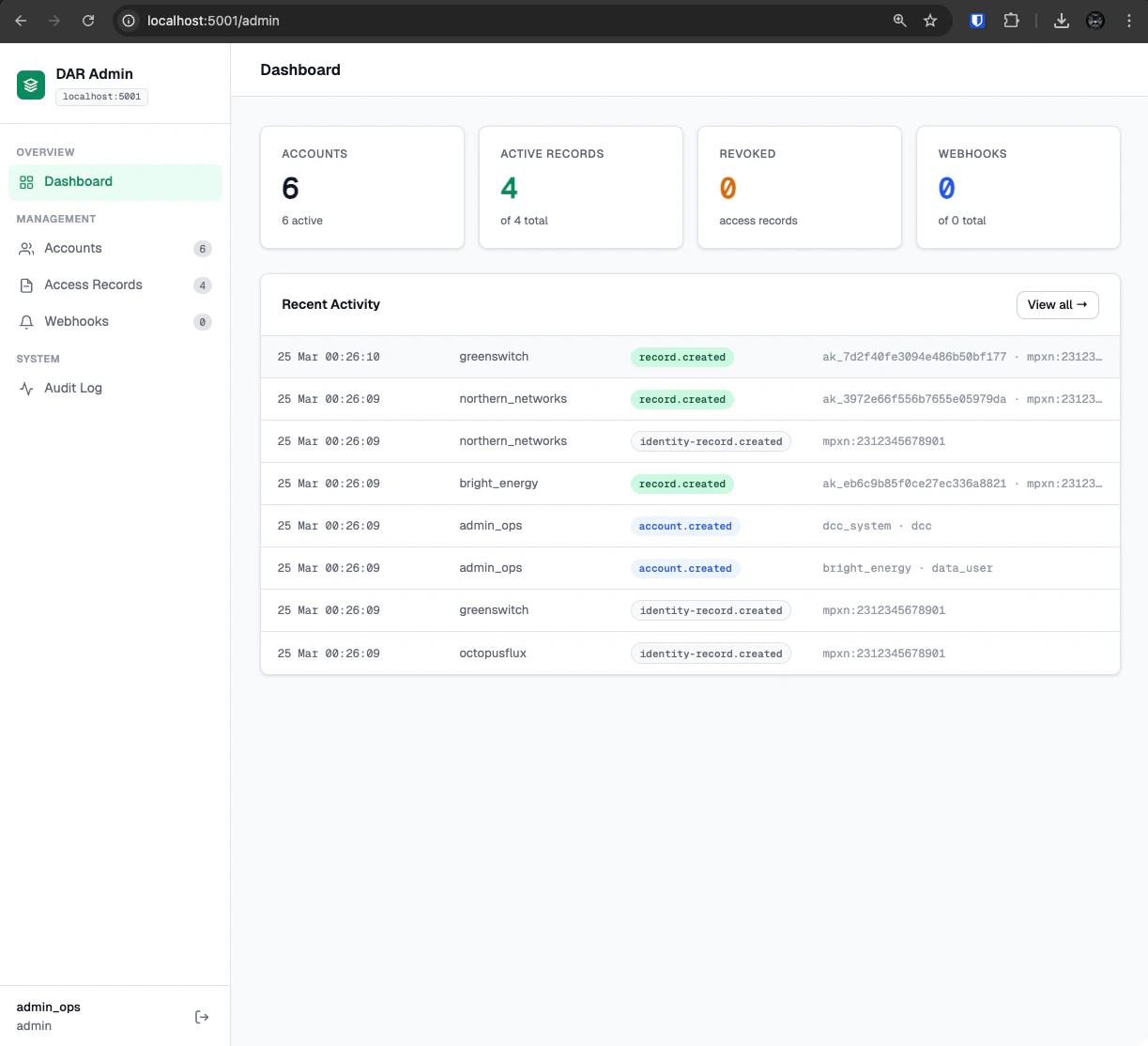
Customer Portal
What a customer sees when they ask who has access to their meter data.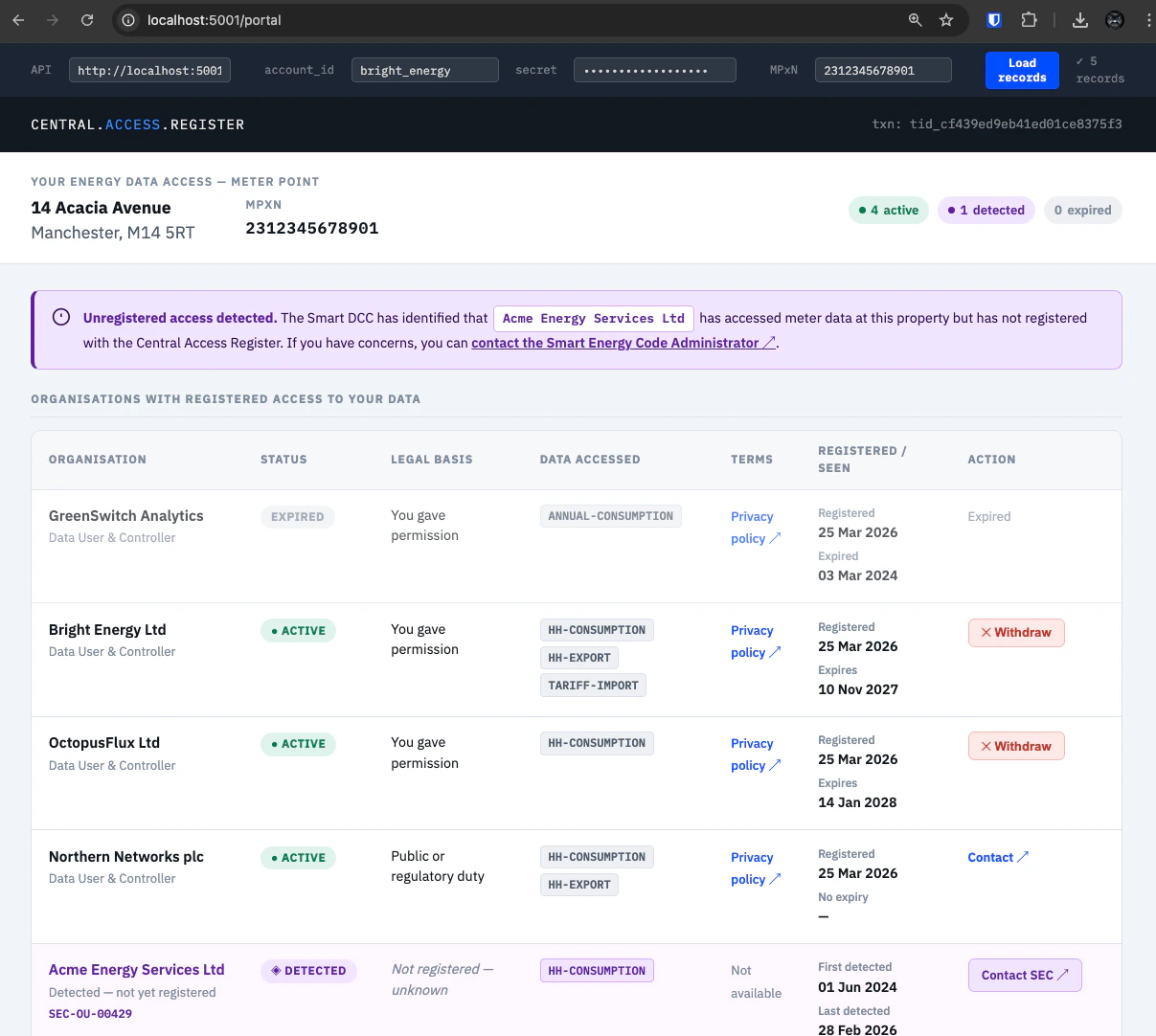
- Two active consent records with Withdraw buttons
- One active public task record (no withdrawal available — regulatory basis)
- One unregistered organisation detected by the DCC, surfaced for transparency
- One expired consent record retained for audit
Data User Dashboard
The self-service view for a registered Data User.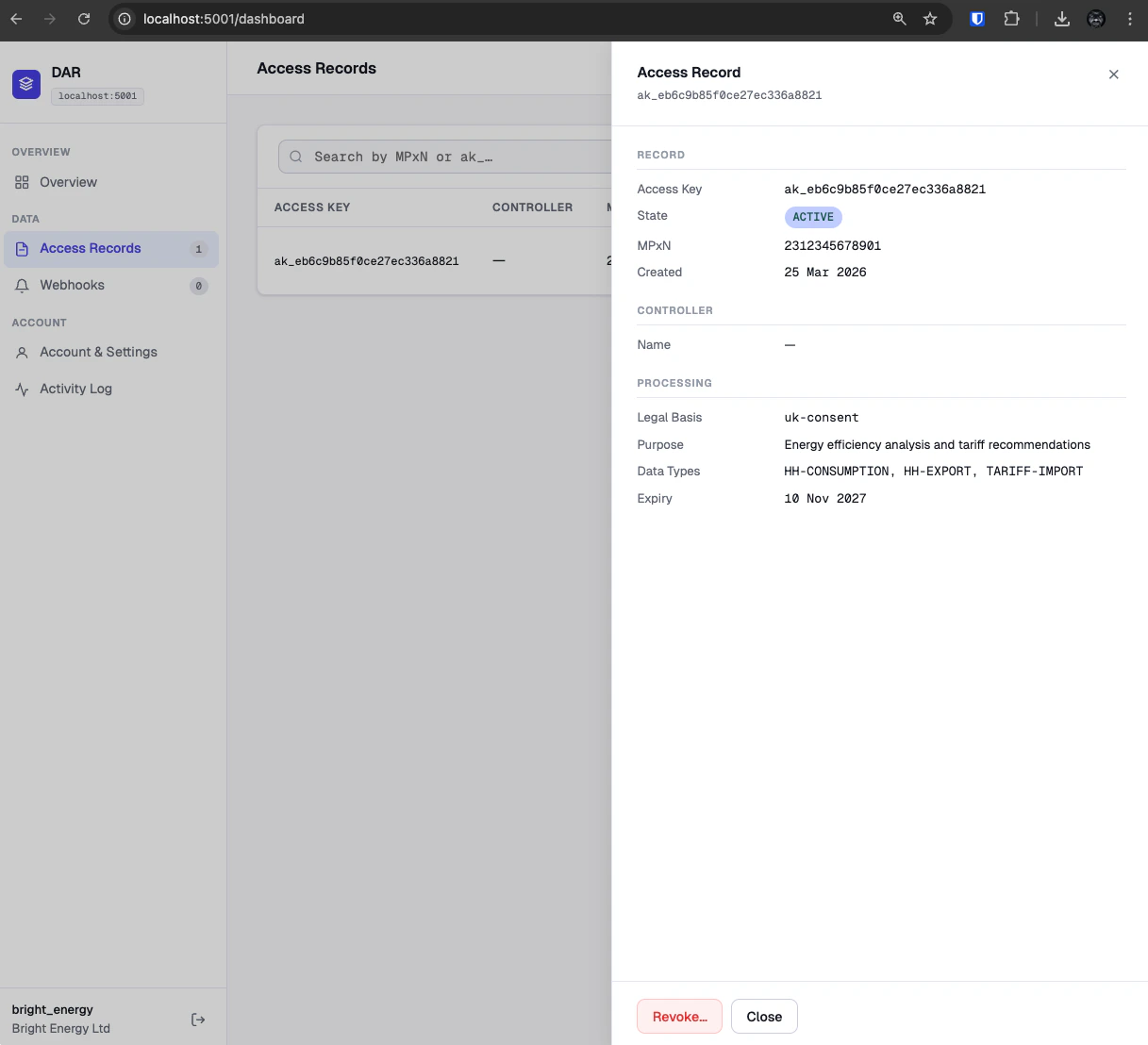
What the Demo Shows Together
The three interfaces together demonstrate the central proposition: a single register that serves every party’s needs from one data model.- The operator has complete visibility and audit capability without depending on Data Users to self-report
- The customer has a single, honest view of who holds access to their data — including parties who have not yet registered
- The Data User has a clear record of their own registrations, lifecycle events, and obligations
- The Data Provider has an unauthenticated, PII-free verification endpoint they can call on every data request
Try It Yourself
The full reference implementation is available to download and run locally. It includes the API, all three browser interfaces, a Docker Compose stack, and a seed script that recreates the demo data shown here.- Source: github.com/AuthEnergy/dar
- Setup guide: DEMO.md